CENTRAL PUBLIC HALL
History of the Public Hall
History
About the History of the Public Hall
Iwamoto Einosuke
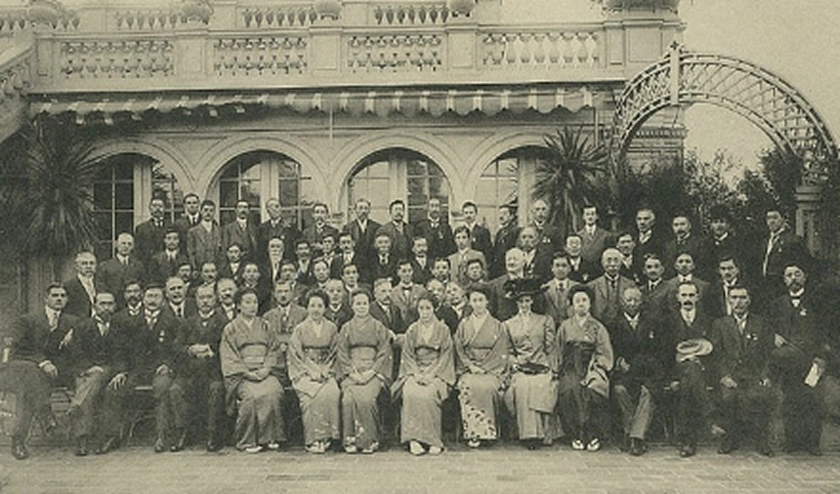
American Business Delegation
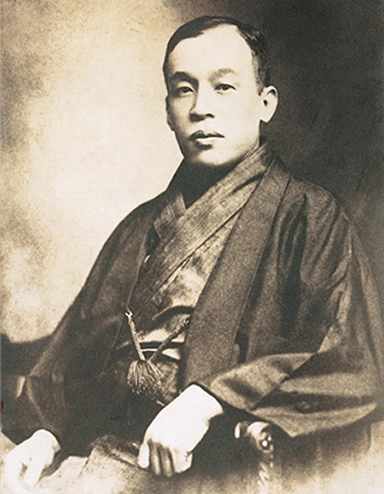
The Public Hall that can be called a symbol of Nakanoshima and of Osaka City. Once, there was a person who invested enormous private wealth for its birth, yet left this world without waiting for its completion. That person was Iwamoto Einosuke, a stockbroker also known as the 'chivalrous speculator'. Iwamoto Einosuke was born in 1877 (Meiji 10) as the second son of 'Iwamoto Shoten,' a money changer located in Osaka City's Minami Ward (now Chuo Ward). After graduating from elementary school and advancing to Osaka Municipal Commercial School, he attended foreign language schools while helping with the family business. In 1904 (Meiji 37), he was drafted for the Russo-Japanese War. After his discharge, in March 1906 (Meiji 39), he inherited the family headship and was officially registered as a broker at the Osaka Stock Exchange. In May 1906 (Meiji 39), immediately after Einosuke became a broker, an unprecedented surge triggered by the end of the Russo-Japanese War hit the Osaka Stock Exchange in Kitahama. Stock prices soared rapidly, and it was whispered that 'if you buy, you will surely profit.'
At this time, most Kitahama brokers had taken selling positions, anticipating an eventual crash. However, the stock price surge did not stop, and many brokers were pushed to the brink of bankruptcy. They then turned to Einosuke for help. They wanted him, who had conservatively taken buying positions, to switch to selling and bring down stock prices. Einosuke readily agreed to this extraordinary request to give up the profits he had gained as a buyer. He replied, 'I'll cooperate thinking of it as repaying the kindness to everyone who has helped us since my father's generation.' As a result, stock prices crashed dramatically on January 21 of the following year. The Kitahama brokers who had taken selling positions avoided bankruptcy and gained enormous profits, and Einosuke himself also gained significant profits. The Kitahama brokers are said to have expressed their gratitude, saying 'We cannot sleep with our feet pointing toward Mr. Iwamoto.' Furthermore, Einosuke, whose catchphrase was 'You must study,' encouraged boys working at the stock exchange to attend school and invested his private funds to establish a private school for them. This made him increasingly popular, and he was praised as the 'Young Dragon of Kitahama.' From the beginning of his work as a broker, Einosuke had a strong interest in using profits from stocks for public benefit. What further strengthened this desire was his participation in the 'American Business Delegation' in 1909 (Meiji 42).
Setting foot on foreign soil for the first time, Einosuke was deeply impressed by how many wealthy Americans were investing their fortunes and estates in charitable and public works. He resolved to build a hall in Osaka that would rival any other. During the journey, upon receiving news of his father Eizo's death, Einosuke returned urgently to Japan and donated 1 million yen to Osaka City, combining his father's inheritance of 500,000 yen with his own assets. This was an enormous sum, equivalent to several billion yen in today's currency. Initially, various plans were proposed, including parks and school facilities, but the construction of a public hall was ultimately chosen, reportedly due to his mother's advice to 'create something that anyone can use.'
Though Einosuke withdrew from the front lines of stock brokering in 1914 (Taisho 3), he returned to the world of stock brokering the following year. However, he suffered enormous losses in the inflated market caused by the outbreak of World War I. People around him advised him to ask for at least partial return of the 1 million yen donated to Osaka City, but Einosuke refused, saying 'Asking for the return of something once donated is a shame for an Osaka merchant.' In October 1916 (Taisho 5), he chose to commit suicide by pistol at his home. During the five days that Einosuke hovered between life and death, the Kitahama brokers who owed him a debt of gratitude kept bonfires burning through the night at Osaka Tenmangu shrine, praying for his recovery. On October 27, Einosuke ended his life at the age of 39. The public hall that Einosuke dreamed of was completed in November 1918 (Taisho 7), two years after his death. It is now designated as a National Important Cultural Property and continues to be cherished as a center for citizens' cultural and artistic activities.
Iwamoto Einosuke's Death Poem
「Without waiting for autumn, the maple leaves scatter away」
Timeline
Preservation and Restoration Project
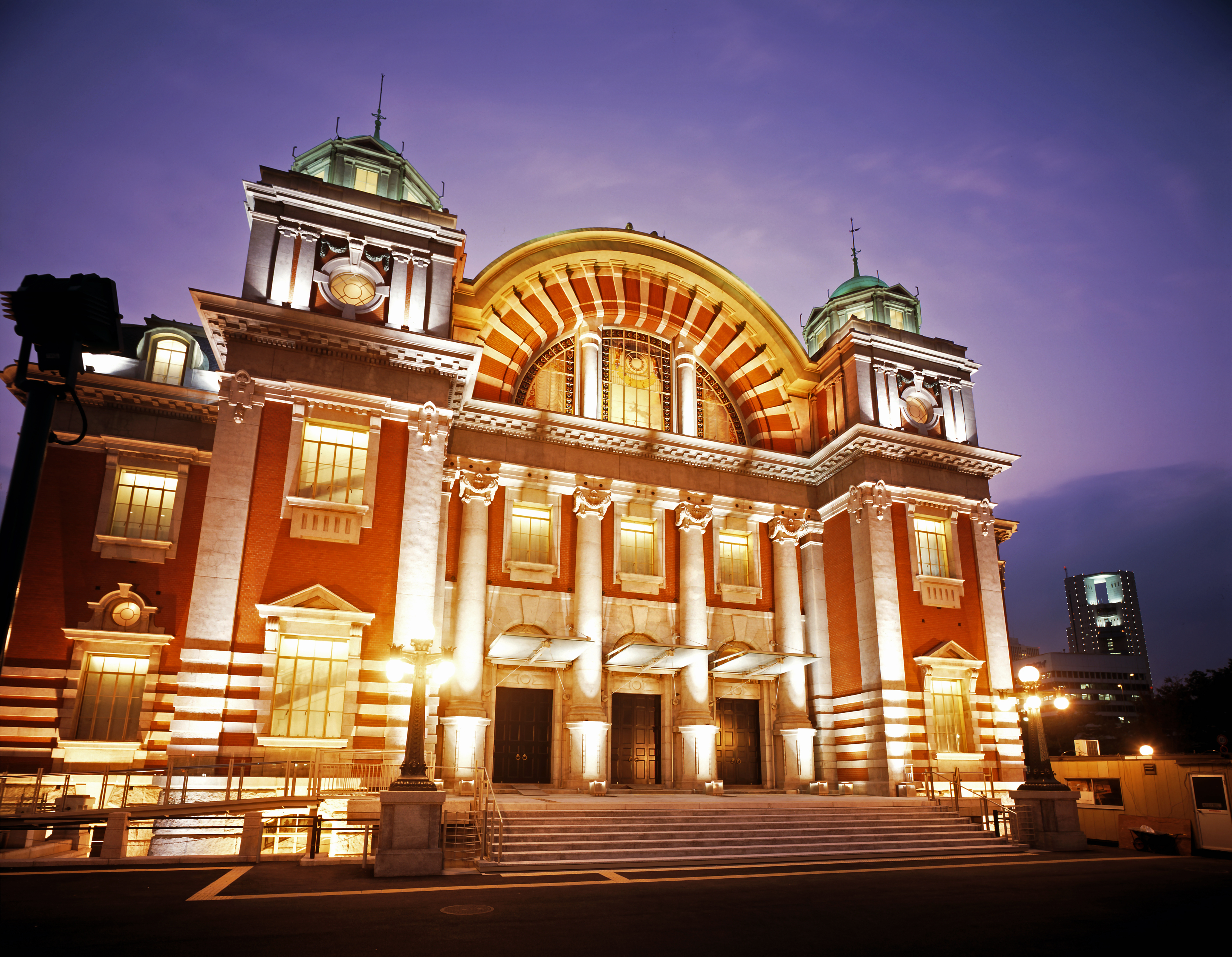
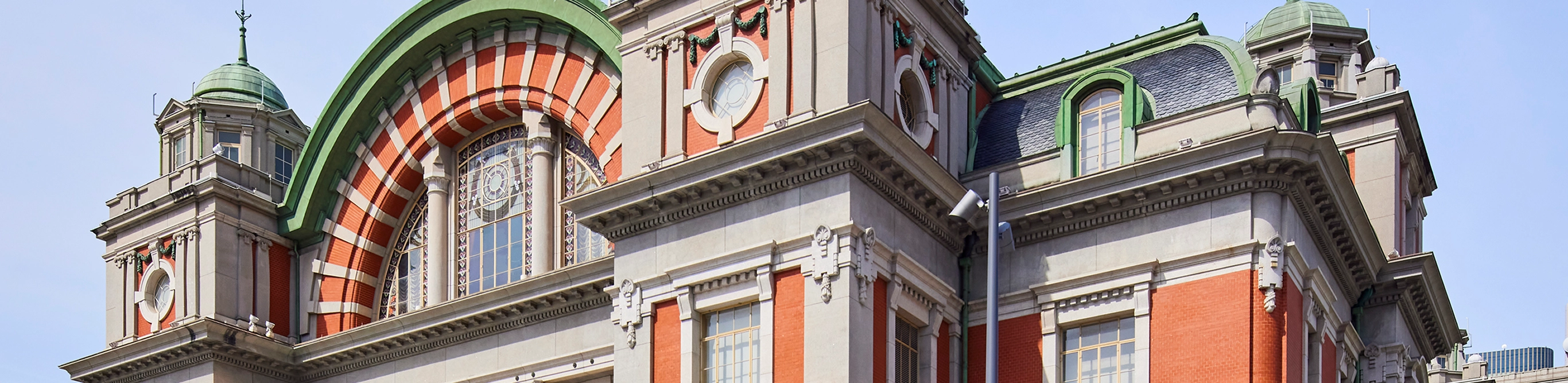
Osaka City Central Public Hall construction began in spring of Taisho 2 (1913) and was completed in October of Taisho 7 (1918) after five years of work involving a total of 184,000 craftsmen.
The structure is steel-frame brick construction with three floors above ground and one basement floor, covering a site area of 5,641m², building area of 2,164m², and total floor area of 8,425m² in Neo-Renaissance style. The Central Public Hall, which concentrated the essence of architecture in every detail from room designs, stained glass, and chandeliers to the design of stairs and doors, has been used since its construction for various events from lectures, meetings, concerts, and theater performances by celebrities to citizen-level activities, deeply involved in modern Osaka's cultural and social history.
However, as a building constructed before the Great Kanto Earthquake, its insufficient earthquake resistance had long been noted. Beginning with major interior renovations 19 years after completion in 1937 (Showa 12), various renovation works were subsequently carried out to update facility functions. Despite this, significant deterioration became evident in the roof and exterior walls due to aging, and problems began to emerge in equipment and functionality, leading to discussions about demolishing or rebuilding the structure. (*)
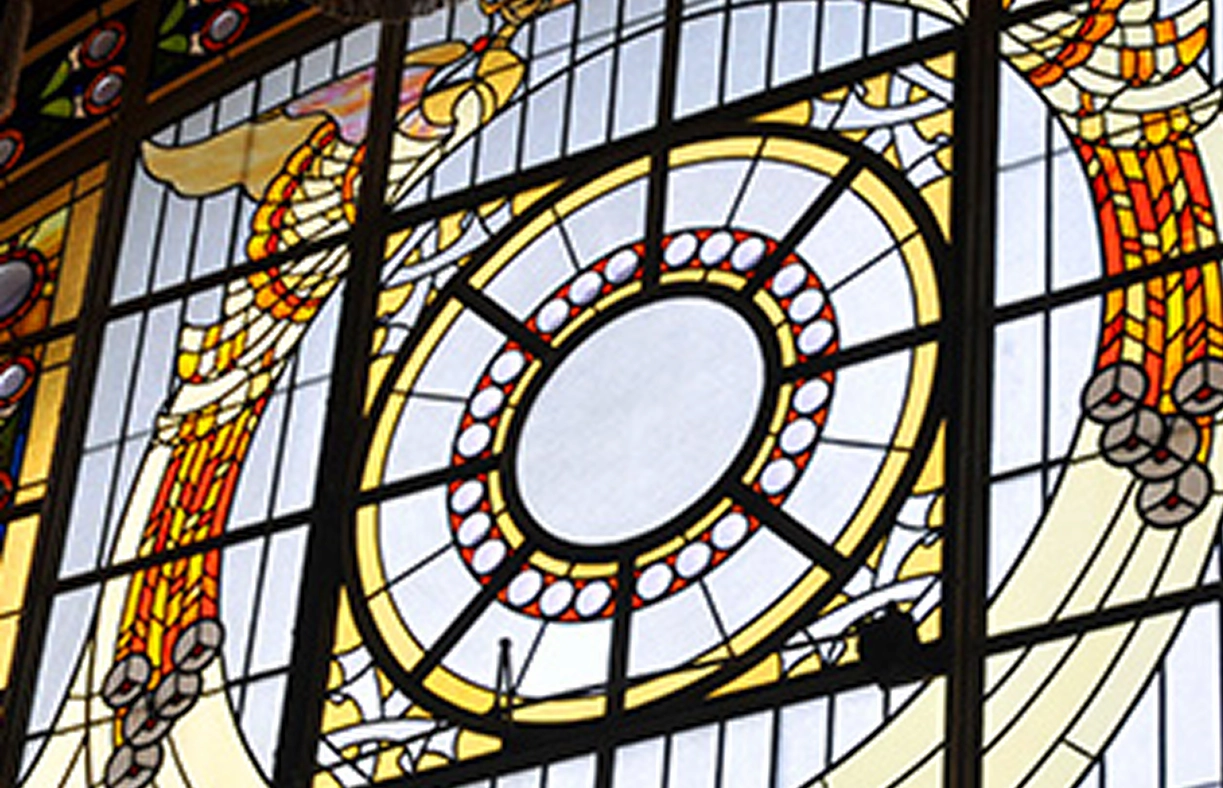
Special Room: Stained glass restored to its former glory